6
Elimination of Expensive Standardized Headplates
Conventional bioreactor headplates scale with vessel size, forcing laboratories to purchase dedicated headplate assemblies and varying probe lengths whenever scaling operations. The Minifor2Bio touch standardizes neck dimensions across all vessel capacities (0.3" L" , 0.4" L" , 1" L" , 3" L" , and 7" L" ). As a result, probes ("pH" , 〖"pO" 〗_2, temperature, antifoam) and accessory ports are interchangeable across all vessel sizes without purchasing duplicate sensors.

Bye - Bye to Head Plates
Traditional laboratory bioreactors typically employ stainless-steel head plates to support the agitation system, process probes, sampling ports and fluid connections. Although this design has become an industry standard, it introduces considerable mechanical complexity, increases manufacturing costs and often limits accessibility, particularly in small laboratory-scale vessels.
The LAMBDA Minifor2Bio touch adopts a different engineering philosophy by eliminating conventional head plates and replacing them with a threaded borosilicate glass vessel. This simplified architecture improves accessibility, reduces the number of mechanical components and significantly lowers the cost of operating vessels of different sizes.
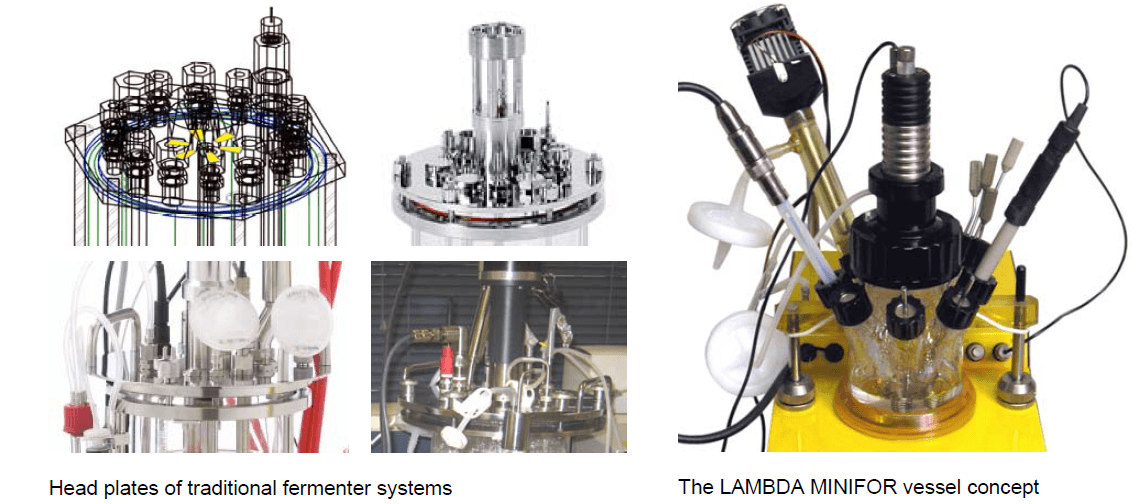
Fig: Conventional head plate compared with the threaded vessel concept of the LAMBDA Minifor2Bio touch.
Engineering Concept
Conventional head plates were originally developed for large industrial fermenters and later adapted to laboratory-scale systems. While effective, scaling this design down creates several practical limitations. The limited surface area of small head plates results in closely spaced ports, making the installation and removal of probes and fittings difficult. The large number of threaded connections, O-rings and fastening screws also increases assembly time and the risk of leakage or contamination.
Each vessel volume typically requires a dedicated head plate together with vessel-specific accessories, including longer or shorter pH, dissolved oxygen, temperature and antifoam probes, as well as different lead-throughs, nuts and sealing components. Consequently, changing vessel size often requires substantial additional investment.
The LAMBDA Minifor2Bio touch eliminates these limitations through a threaded vessel architecture. The agitation and aeration assembly is mounted through a large threaded central neck, while process probes and accessories are installed through multiple threaded side ports sealed with reusable multi-seal silicone stoppers. This arrangement simplifies vessel construction while maintaining excellent accessibility from all sides.
The elimination of conventional head plates is made possible by several complementary engineering concepts. The non-rotational mixing system removes the need for internal baffles and large central vessel openings, while the infrared radiation heating system eliminates the requirement for jacketed vessels. Together, these innovations enable a compact, lightweight and modular vessel platform.
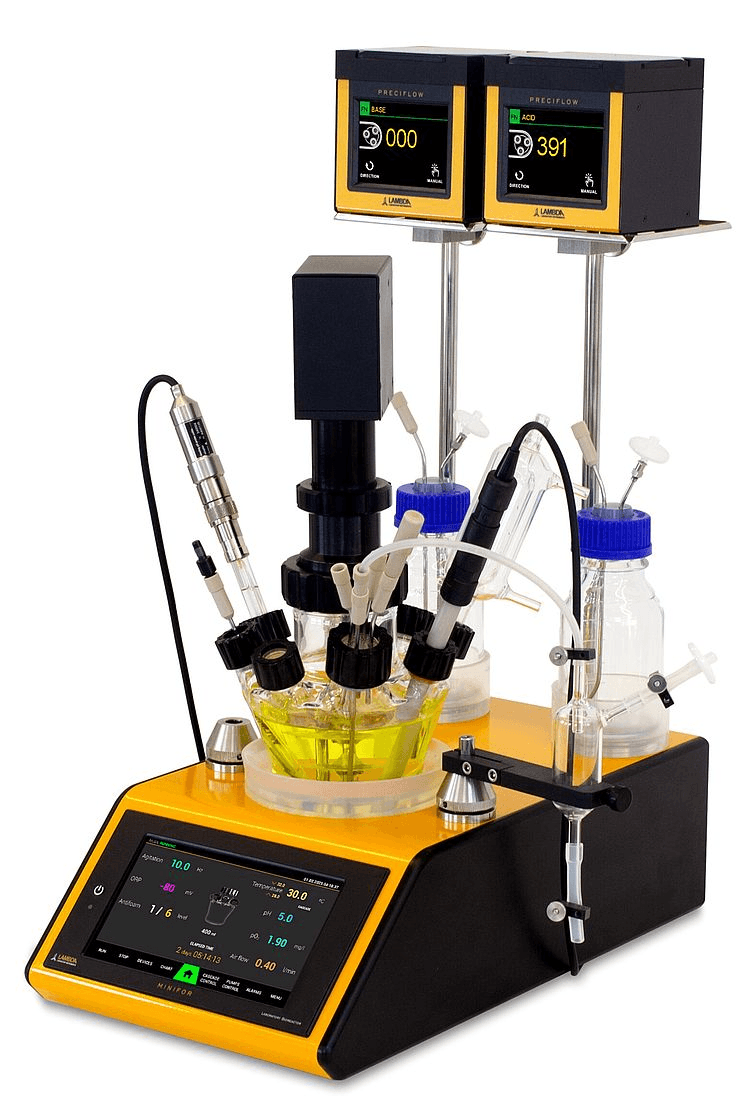
Fig: Threaded vessel architecture with distributed process ports.
Design Advantages
Removing the conventional head plate significantly reduces the number of mechanical components, sealing interfaces and consumable parts required for routine operation. The reusable silicone sealing system replaces multiple O-rings, reducing maintenance while improving long-term sterility and reliability.
The modular vessel platform allows interchangeable working volumes from 35 mL to 7 L using the same control unit, probes and most accessories. Only a small number of low-cost components are changed when switching vessel sizes, substantially reducing the cost of process development and scale-up.
This flexibility allows researchers to select the smallest appropriate vessel volume for each experiment, minimizing media consumption, sterilization time, cooling time and downstream processing costs. Smaller vessels are also easier to handle during routine laboratory work while maintaining the same level of process control and experimental reproducibility.
By replacing the traditional head plate with a simplified threaded vessel architecture, the LAMBDA Minifor2Bio touch reduces system complexity while improving accessibility, flexibility and cost-efficiency across the complete laboratory-scale working volume range.