UNIQUE EASY STERILITY CONSTRUCTION
Maintaining long-term process sterility during extended continuous fermentations is simplified by removing all rotating mechanical penetrations. All sensors, feed lines, and gas outlets connect via elastic silicone stoppers and double-sealed multi-needle ports. The complete glass vessel assembly—including probes and tubing—can be autoclaved as a single unit without needing hot steam-in-place (SIP) utility lines.

STERILITY BY DESIGN
Sterility is one of the most critical requirements in bioprocessing. Maintaining a contamination-free environment throughout cultivation is essential for obtaining reliable and reproducible experimental results. This is particularly important for long-term fermentations and continuous cultures, where contamination may result in the loss of valuable time, materials and experimental data.
The LAMBDA Minifor2Bio touch was designed with the objective of simplifying sterility by eliminating the mechanical components that are most commonly associated with contamination risks. Instead of relying on increasingly complex sealing mechanisms, the system minimizes the number of critical sealing interfaces while maintaining complete separation between the sterile culture and the external environment.
Engineering Concept
The foundation of the Minifor2Bio touch sterility concept is the combination of the non-rotational mixing system and a large elastic silicone membrane. Since the stirring shaft moves vertically rather than rotating, the membrane can accommodate the reciprocating motion while providing complete physical separation between the culture vessel and the surrounding environment. This sealing concept offers sterility comparable to magnetic coupling while requiring significantly fewer mechanical components.
The vessel incorporates multiple threaded side ports sealed with permanent multi-seal silicone stoppers. Unlike conventional O-rings, which gradually flatten during repeated sterilization cycles and require regular replacement, the multi-seal stoppers maintain reliable sealing over repeated use while minimizing routine maintenance and operating costs.
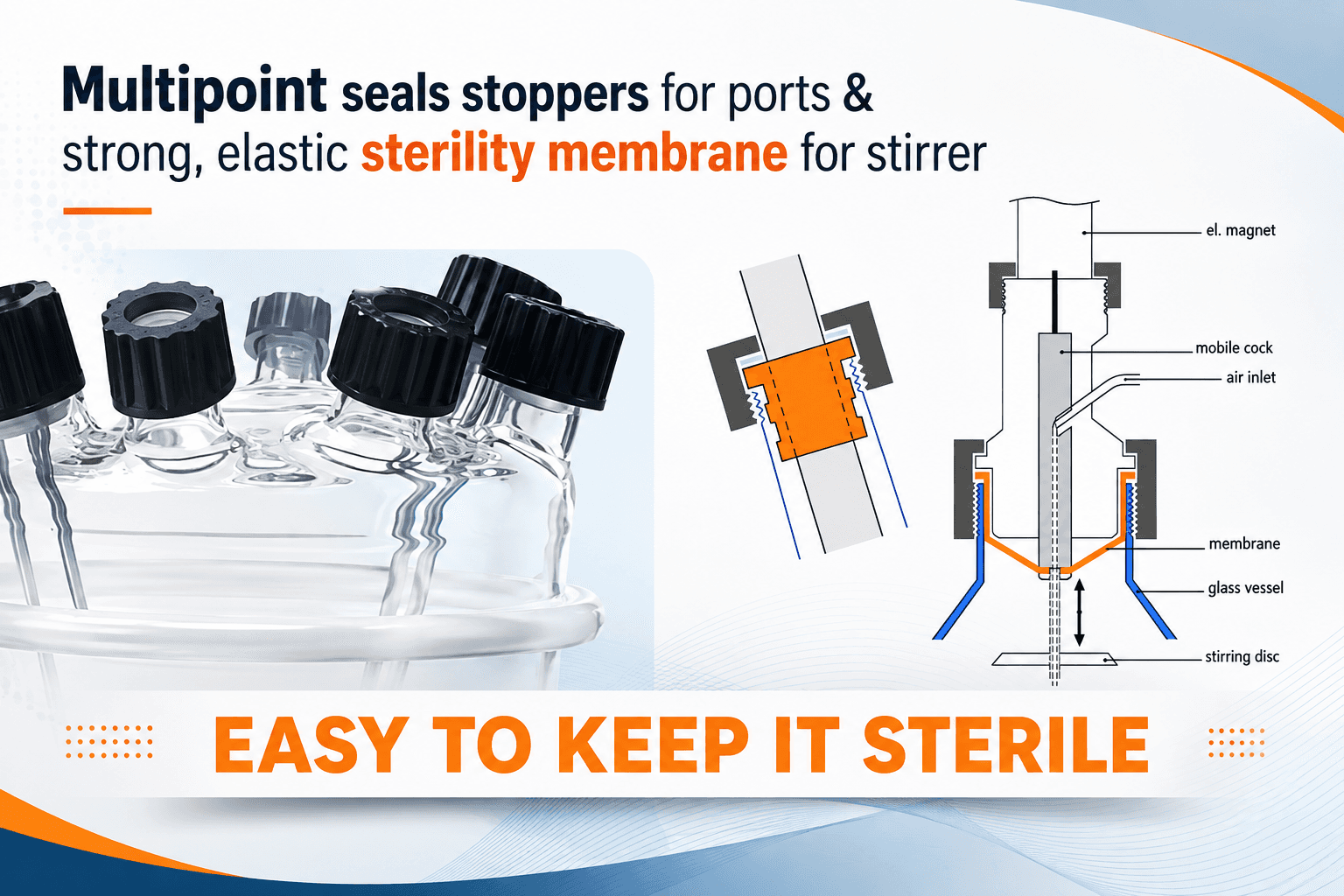
All tubing connections between the vessel, media bottles and accessories are made using LAMBDA double-seal tubing connectors, further reducing the possibility of contamination throughout the fluid transfer system.
The threaded vessel architecture also simplifies reactor assembly. Installing or changing process ports is as straightforward as tightening a threaded cap, significantly reducing preparation time before each cultivation.
Design Advantages
The elimination of conventional rotating shaft seals and multiple O-rings removes two of the most common sources of contamination in laboratory bioreactors. As a result, sterility is easier to establish, maintain and reproduce from one cultivation to the next.
The simplified sealing concept reduces maintenance requirements by eliminating frequent replacement of sealing components while improving long-term reliability during extended cultivation experiments.
The threaded vessel construction also enables faster assembly and dismantling of the bioreactor, reducing preparation time while simplifying cleaning and sterilization procedures. Together with the integrated vessel design, this creates a highly accessible and user-friendly platform for routine laboratory operation.
The sterility concept of the LAMBDA Minifor2Bio touch is not based on adding more sealing components but on reducing the number of potential contamination points through simplified engineering. By combining non-rotational mixing, reusable multi-seal silicone stoppers and double-seal tubing connections, the system provides reliable sterility while minimizing mechanical complexity and maintenance.
Comparison of Sterility Concepts
Feature | Conventional Shaft Seals | Magnetic Coupling | LAMBDA Sterility Concept |
Rotating shaft seal | Required | Not required | Not required |
Elastic membrane | No | No | Yes |
Multi-seal reusable silicone stoppers | No | No | Yes |
Conventional O-rings | Multiple | Multiple | Not required for vessel ports |
Double-seal tubing connections | Optional | Optional | Standard |
Risk of seal wear | Moderate–High | Low | Very Low |
Maintenance requirements | Moderate | Moderate | Low |
Reactor assembly | Complex | Moderate | Simple threaded construction |
Long-term sterility | Good | Excellent | Excellent |